Help you choose which package better fits your specific age and health goals?

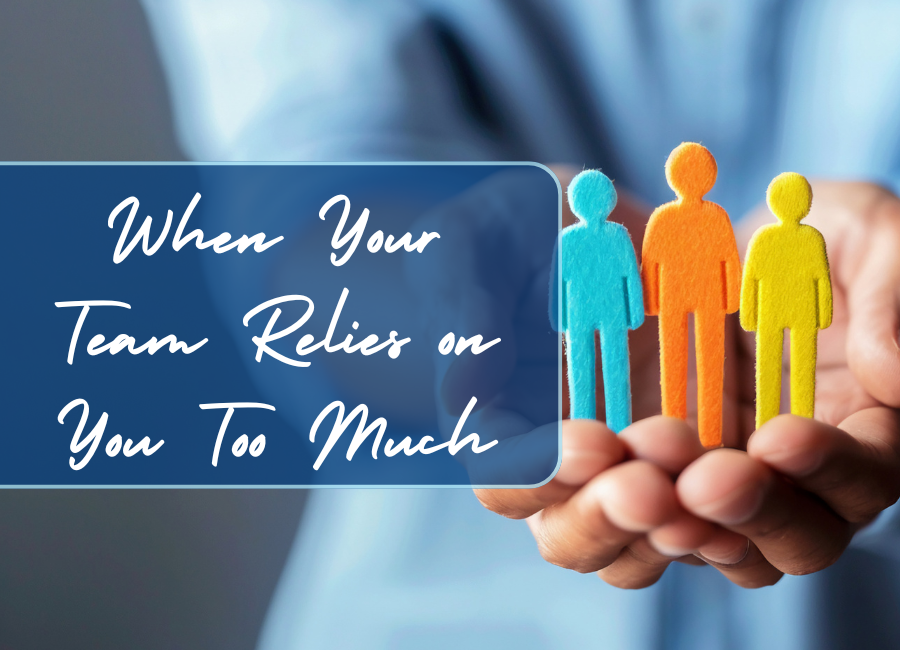
There is a point in many gyms where the owner stops being a leader and starts becoming the answer to everything.
Every question comes to them. Every issue gets escalated to them. Every schedule change, parent concern, coaching problem, payroll question, conflict, and decision somehow circles back to them.
At first, this can feel normal. Even necessary.
After all, you built the gym. You know the families. You know the systems. You know the culture. You care deeply, and you want things done well.
But over time, something shifts.
Instead of leading the business, you are carrying it.
And if your team relies on you too much, it may feel flattering in some moments, but it is not sustainable for you or healthy for the gym.
Dependence Is Not the Same as Trust
A lot of owners confuse dependence with loyalty.
If everyone comes to you, it can feel like proof that you are needed, respected, or central to the success of the business. In some ways, that is true. But if nothing moves without you, the business is not strong. It is dependent.
That is a dangerous place to stay.
Because when the owner becomes the solution to every problem, decision-making slows down, staff confidence weakens, and the gym loses the ability to function well without constant supervision.
That is not leadership. That is bottlenecking.
Overdependence Usually Starts Innocently
Most owners do not create team dependence on purpose.
It often starts because they care. They want to help. They want things handled correctly. They move quickly. They solve problems efficiently. They fill gaps because it feels easier than stopping to teach someone else.
And in the short term, that works.
But over time, the team learns something without anyone saying it out loud: when in doubt, go to the owner.
That pattern becomes culture.
Soon the owner is interrupted constantly, even with questions the staff should be able to answer. The team hesitates to make decisions without approval. Ownership of problems stays low because responsibility has never truly been transferred.
The result is an exhausted leader and a team that never fully grows.
Your Team Cannot Build Confidence Without Responsibility
One of the biggest hidden costs of overdependence is that it prevents staff from developing.
People do not become stronger by watching someone else carry everything. They become stronger by being trusted with responsibility, supported with clarity, and held accountable for outcomes.
When owners keep too much, staff stay underdeveloped. They may be well-intentioned, but they remain hesitant, reactive, or overly reliant on direction.
That creates frustration on both sides.
The owner feels like no one steps up. The staff feels unsure of what they are really allowed to own.
Clear Roles Reduce Unnecessary Reliance
One reason teams lean too heavily on the owner is because role clarity is missing.
If staff do not know what they are empowered to decide, what they are expected to handle, or when they truly need escalation, they will naturally default upward.
That is why clear roles matter.
What problems belong to which people?
What decisions can be made without owner approval?
What standards should guide those decisions?
What should staff try before bringing something to leadership?
These questions create structure. And structure builds confidence.
Delegation Requires More Than Handing Off Tasks
Owners sometimes think they have delegated when they have simply assigned work.
True delegation includes:
- clear expectations
- context
- authority
- accountability
- follow-through
If a staff member has a task but no decision-making power, no framework, and no support, they will still come back to you.
Delegation is not dumping. It is development.
And when it is done well, the owner does not disappear. They simply stop being the only one holding everything together.
The MotUS Perspective
At MotUS, we believe strong leadership is measured not by how much an owner can carry, but by how much they can build beyond themselves.
If your team relies on you too much, that is not a personal failure. It is a signal.
It may be a sign that clearer systems are needed. Better training. Stronger role ownership. Healthier delegation. More consistent leadership communication.
None of that weakens your role. It strengthens the gym.
Final Word
You should be important to your business. But you should not be the only thing keeping it functional.
A great gym cannot be built on owner dependency alone. It needs people who can lead, solve, communicate, and carry responsibility with confidence.
Build a team that does not just lean on you.
Build a team that grows because of your leadership.
That is how the gym becomes stronger.
That is how the owner becomes healthier.
And that is how growth becomes sustainable.