Social Media That Sticks: Showcase Your Gym, Build Your Brand, and Connect With Your Community

Stacy Rowe • December 12, 2025

If you’ve ever left a convention center thinking “did I just walk 25 miles and emotionally age 10 years?”—same. In this week’s ModUS Edge, Stacy, Cole, Kevin, and Casey dig into the messy middle of navigating events: coaching highs and lows, talking with judges, handling parents, and keeping your staff culture intact when half the table is ordering celebratory cheesecake and the other half wants a rain check on life.Here’s your 3-minute, friendly, slightly caffeinated guide—peppered with real-world scripts you can steal.


The Pressure Cooker Is Real (and Normal)


Large events (CheerSport, NCA, CheerExpo Nashville, pick your monster) compress:


  • Months of work → five minutes on the mat
  • 10–15 hour days → 30,000–50,000 steps
  • Pride + fatigue → spicy emotions

Coaches come out either floating (“I am a genius!”) or spiraling (“Do I even know how to coach?”). Both are normal. Build a Day-After Protocol so the pendulum doesn’t decide your season.

Day-After Protocol (steal this):


  1. Feel it (24-hour rule): Celebrate or sulk, but cap it.
  2. Frame it: “We trained well, we learned X, we’ll adjust Y.”
  3. Focus it: Three fixes for practice #1 back.
  4. Forward it: Team message by noon: “Proud of your effort. Here’s our plan.”

Dad-joke breath: Which is faster, hot or cold? Hot—you can catch a cold. (…We’ll show ourselves out.)


Expectations: Your Emotional Safety Net


The difference between devastation and determination is often pre-framing.


  • Newer programs: Define “win” as finals made, zero-deduct routines, or hitting a season-first skill on stage.
  • Established programs: Confidence ≠ cockiness. If “champ or bust” is the only acceptable outcome, you’re one score slip away from a culture crisis.

Huddle line you can use:
“We play to win
and to improve. If we hit our standard, we succeeded. If we also take home metal, that’s dessert.”


Talking to Judges & Event Officials (Without Raising Your Blood Pressure)


Judges want to get it right. They also don’t live inside your choreography brain.

Before you walk up:

  • Circle where they’re right on the sheet. (They usually are on something.)
  • Pick one category to discuss (jumps, stunt difficulty, etc.).
  • Bring a clip if allowed; keep it 2 minutes.

Open with this:


“Coach from [Gym], Level [X]. Thank you for your notes—especially on [specific]. Could you help me calibrate our [category] vs. the range you were seeing? Here’s a 15-sec clip.”


Leave with this:


“Got it—so if we [specific tweak], our target range becomes [X]. Appreciate your time.”

No monologues. No sarcasm. No “my kids worked too hard” (everyone’s kids did).


Parent Dynamics: From Squabbles to Support Squad


Fatigue + money + travel = feelings. Set lanes before you load the bus.

Pre-event parent note (edit and send):


  • Priority Viewing = cheer zone, not debate stage.
  • Scores & placements discussed by staff only.
  • If emotions spike, text the team number “PAUSE” and we’ll regroup after awards.
  • Your best job today: film smiles, pack snacks, high-five often.

At the event:
If tempers flare: “I hear you. We’ll review scores and the video and update by [time]. Right now we’ve got kids to coach.”


When It Falls Apart in Warm-Up (and It Will Someday)


An injury, a popped layout, a last-minute replacement—welcome to coaching.


In-the-moment script:


  • To the athlete: “You’re safe, we’ve got you. Breathe.
  • To the team: “We adjust and execute. Count matters more than choreo.”
  • To the score: “Clean > cute.” Strip to the reliable.

Later, honor the athlete and the work. You’re building humans, not just routines.


Dinner Table Diplomacy


One end of the table is planning a victory lap; the other end is googling “new careers.”


  • Seat by project, not placement. Pair a coach who’s flying high with one who needs perspective.
  • Toast process wins (hit rate, upgraded stunt, best coverage) before placements.


Feedback Is a Gift (Even When It Feels Like a Cactus)


It stings because you care. Make “gift” your team’s reflex.

Staff debrief template:


  • 2 things the judges nailed
  • 1 thing we disagree on (and why)
  • 3 changes we’ll try by next practice

Bonus tip: Record a 2-minute Loom (or phone video) summary for parents: what the sheet said, what we’re changing, how they can help (sleep, nutrition, mindset).


Winning Changes Your Culture—Guard It


Sustained winning sneaks in entitlement if you’re not ready.


  • Celebrate standards, not just statuses. (“We hit our expectation for technique,” not “We’re Stingrays, of course we won.”)
  • Rotate credit widely: stunt group of the week, unsung hero, best teammate.
  • Make “Can I get help?” a strength, not a scarlet letter.


Quick Event-Day Checklist

  • Expectation email (athletes & parents) sent 48 hrs prior
  • Coach roles for warm-up & mat (caller, fix, spot, calm)
  • Judge plan: 1 category, 2 minutes, 1 ask
  • Parent captain assigned (snacks, seats, smiles)
  • Post-day message scheduled (pride + plan)
  • Day-After Protocol on deck


You’ll laugh, you’ll nod, you’ll steal at least two lines. For the full conversation (and more chapstick discourse than anyone expected), dive into the episode:


The MotUS Edge Podcast – YouTube: https://www.youtube.com/@themotusedge
The MotUS Edge Podcast – Apple: https://podcasts.apple.com/us/podcast/the-motus-edge/id1786597546
The MotUS Edge Podcast – Spotify: https://open.spotify.com/show/63xUjmymxRiXHkSSEjlfOD?si=e5036453706148d9&nd=1&dlsi=02e897fb37a148ce


By Stacy Rowe September 11, 2026
Most gym owners spend a lot of time thinking about how to get new families in the door. That makes sense. New enrollments feel like growth. Marketing feels proactive. Recruitment feels exciting because it is visible. It gives the business momentum and creates the sense that something is moving forward. But one of the most important business shifts a gym owner can make is realizing that growth is not just about recruitment. It is about retention. Because if families are leaving as quickly as new ones arrive, the gym is not really growing. It is cycling. And in today’s environment, where trust, experience, and consistency matter more than ever, keeping families may be one of the most important business priorities an owner can focus on. Recruitment Gets Attention, Retention Builds Stability Recruitment tends to get more energy because it is easy to measure and easy to celebrate. New trial. New athlete. New enrollment. New family. Retention is quieter. It lives in the day-to-day experience. In the way communication is handled. In how staff engage. In whether families feel seen, supported, and clear about what comes next. That is why it is sometimes overlooked. But retention is what creates stability. It protects revenue. It strengthens culture. It reduces the pressure to constantly replace lost athletes. And it gives the owner more breathing room to grow strategically instead of reactively. Families Stay for More Than the Sport A lot of gym owners assume families leave mainly because of schedule, price, or athlete interest. Sometimes that is true. But often, the decision to leave is influenced by a much broader experience. Families stay where they feel connected. They stay where communication is clear. They stay where expectations are consistent. They stay where problems are handled well. They stay where the environment feels organized and trustworthy. The quality of the experience matters just as much as the quality of the coaching. That does not mean every family will stay forever. But it does mean retention is shaped by a lot more than performance results or talent level. Retention Lowers Pressure Across the Business When retention is strong, everything feels different. Marketing becomes more effective because the gym has a stronger reputation. Staff stress decreases because there is less constant turnover. Revenue becomes more predictable. Team culture gets stronger because relationships last longer. Most importantly, the owner stops feeling like every season starts from zero. That is what constant churn does. It creates emotional and operational exhaustion. Even when the gym looks active from the outside, the business feels unstable on the inside because it is always trying to refill what just left. Retention changes that rhythm. Retention Starts Before Problems Show Up Too many owners think about retention only when someone is already unhappy. By then, you are in recovery mode. The strongest retention strategies start much earlier. They are built through proactive communication, strong onboarding, family education, consistent service, and clear pathways for athletes to continue growing in the gym. Retention is not a last-minute save. It is an ongoing experience. Ask yourself: Do families know what to expect? Do they understand your value? Do they feel informed? Are transition points handled well? Are concerns addressed early? Do athletes feel like they belong here? These are retention questions, even if they do not sound like marketing or sales. The Most Expensive Family to Replace Is the One You Already Had Recruitment takes time, energy, and money. Retention protects all three. Every time a family leaves, the gym does not just lose tuition. It often loses referrals, trust, momentum, and community connection. Replacing that family usually requires more effort than keeping them would have. That is why retention is not just a service issue. It is a business issue. The strongest gyms understand that keeping families is not passive. It is strategic. The MotUS Perspective At MotUS, we believe gym owners should absolutely market their business and keep building visibility. But recruitment and retention are not competing priorities. They are connected. If your gym is attracting new families but not keeping them, the issue is rarely just marketing. It is often experience, systems, clarity, or culture. Retention deserves just as much attention as recruitment because it is what turns activity into sustainability. Final Word New families matter. Growth matters. Visibility matters. But keeping the families you already worked so hard to earn matters just as much. Build an experience people want to stay connected to. Build communication people can trust. Build systems that create confidence. Build culture that gives families a reason to stay. Because the strongest gyms are not just good at attracting people. They are good at keeping them.
August 28, 2026
If you coach long enough, you start to see the same pattern. An athlete looks flat at practice. Another gets dizzy at competition. Someone keeps getting sick. Someone else is strong, talented, and committed, but their energy crashes halfway through the day. And too often, the answer is not about skill. It is about fuel. That is what made this episode of The MotUS Edge so important. In this conversation, Brittany Sterkle of Motion Athletics shares a perspective every gym owner, coach, and parent needs to hear: nutrition is not a side topic. It directly impacts performance, recovery, injury prevention, confidence, and long-term health. And when we are talking about young athletes, that conversation has to be handled with both wisdom and care.  From small beginnings to building something meaningful Brittany’s story is one a lot of gym owners will recognize. She started Motion Athletics in Montana with just 12 athletes and one senior team. At the time, competitive cheer was barely established in her area. Montana had gymnastics. Montana had dance. But competitive cheer was still new territory. Like so many owners in the early years, she was figuring it out as she went. She admits she did not fully understand score sheets. She was entering divisions without fully grasping how the system worked. She was building a program in a market with very few nearby gyms and very little built-in infrastructure. That honesty is part of what makes her story so relatable. Because every strong gym owner has some version of that beginning. You start with passion, limited resources, and a whole lot of learning on the fly. Brittany talked about running the gym, coaching college cheer, personal training, raising three kids, and doing whatever it took to keep the dream alive. It took six or seven years before the gym became a full-time income. That is the reality of gym ownership. It is not glamorous at the beginning. It is survival mode mixed with purpose. And maybe that is why Brittany’s perspective on athlete wellness feels so grounded. She has built her program from the floor up, and she knows what really matters. Why nutrition matters more than many programs realize One of the strongest themes in this episode was simple: nutrition affects everything . Not just body composition. Not just aesthetics. Not just “healthy habits.” Everything. It affects: performance recovery injury rates hydration mental focus illness resistance confidence emotional regulation That is a big list, and yet many programs still treat nutrition like a side note. Brittany does not. She speaks about it as a core part of athlete development, and she is right to do so. When athletes are under-fueled, they are not just tired. They are more vulnerable. They are more likely to underperform, more likely to get hurt, and more likely to struggle mentally and emotionally. That does not mean coaches need to become dietitians. It means coaches need to care enough to pay attention. The conversation gets more important when body image enters the room What made this episode especially strong was Brittany’s honesty about her own experience. She shared that she has struggled with eating disorders and that part of her growth has been learning to shift the focus from being “skinny” to being “strong.” That matters. Because athletes are absorbing messages all the time. From social media. From peers. From uniforms. From trends. From comments that adults think are harmless. From the culture around them. If we are not careful, young athletes can start to believe that being a great cheerleader means looking a certain way. It does not. Brittany made that point clearly: all body types belong in cheer . Tall athletes are needed. Strong athletes are needed. Flexible athletes are needed. Power athletes are needed. Different builds bring different strengths. The goal is not to shape every athlete into one image. The goal is to help each athlete become healthy, confident, and capable in their own body. That is a message more gyms need to say out loud. Sometimes the most powerful moments are the most personal ones One of the most moving parts of the episode came when Casey shared his family’s experience with his daughter’s eating disorder. He talked about her being hospitalized at 13 and what that taught him as a parent. One of the biggest lessons was this: no food is “bad food.” Sometimes eating something is far better than eating nothing. That kind of honesty matters because it brings the conversation back to reality. Nutrition is not just about ideal meal plans and perfect macros. It is also about the emotional reality of feeding young athletes who may be nervous, overwhelmed, stressed, image-conscious, or simply not hungry when they should be eating. That is why black-and-white messaging can be so harmful. When kids are taught to fear food, label food as “good” or “bad,” or tie eating too closely to body image, the result is often shame, not health. And shame does not make athletes stronger. Keep nutrition simple One of the best things Brittany said in this episode was that nutrition should be kept simple . That is good advice. In a world full of overcomplicated health trends, parents and athletes do not usually need more confusion. They need clear, practical habits they can actually follow. Brittany’s recommendations were refreshingly straightforward: drink water use electrolytes when needed eat carbs and protein refuel after practice keep snacks accessible do not overcomplicate it That kind of approach works because it is sustainable. She also shared that she brought in a professional to create a basic meal plan and holds an annual nutrition talk for athletes. That is smart leadership. She is not trying to be everything herself. She is creating access to better information and reinforcing it in a consistent way. That is the kind of system gym owners can learn from. Coaches do not need to become nutrition experts, but they do need to notice patterns This episode made another important point: coaches should be paying attention. Not in a controlling way. Not in a body-policing way. But in a caring, observant way. Brittany talked about asking athletes what they ate and reminding them to refuel after practice. That may sound small, but it adds up. It tells athletes that fuel matters. It reminds them that preparation is not just about showing up in uniform. It also helps coaches identify patterns. If an athlete is consistently low energy, lightheaded, nauseous, or unfocused, that is not always “attitude.” Sometimes it is lack of fuel. Sometimes it is dehydration. Sometimes it is both. And when adults in the room learn to ask better questions, they can often prevent bigger issues later. Competition days are where weak fueling habits show up fast Any coach or parent who has lived through a long competition weekend knows this is true. Athletes get nervous. They do not want to eat. Their stomach feels weird. They say they are “fine.” Then halfway through the day they are shaky, emotional, exhausted, or mentally checked out. That is why Brittany keeps simple snacks on hand and why team lunches have become a standard part of how they operate. Sandwiches. Granola bars. Easy carbs. Something quick and practical. That matters more than people think. You cannot ask athletes to perform high-level routines on empty. You just cannot. Hunger affects timing, focus, explosiveness, stamina, and overall safety. The more intense the day, the more important the fueling plan becomes. This is not extra. It is part of the performance plan. Gym culture affects nutrition more than people think One of the smartest parts of the episode was how naturally the conversation moved from nutrition into gym culture. Because those two things are connected. If your gym culture is appearance-driven, your athletes will feel it. If your gym culture celebrates tiny bodies over strong bodies, your athletes will feel it. If your gym culture allows negative body talk, comparison, or pressure around uniforms, your athletes will feel it. Brittany shared that she bans crop tops in her gym because she wants athletes to feel confident. Kevin and Casey agreed with that approach. Their point was clear: protecting confidence matters more than trends . That is not about being anti-fashion. It is about creating an environment where athletes can train without constant body comparison and self-consciousness. That kind of leadership sets a tone. And for young athletes especially, that tone matters. A healthy athlete is not just a physically prepared athlete One of the strongest themes in the episode was that coaching should change lives, not just routines. That showed up in the Simon Sinek quote they discussed: “In order to stand out, we first have to know what we stand for.” Brittany’s answer reflected exactly what strong programs should aim for: integrity, values, and life impact. That applies to nutrition too. A gym that stands for athlete wellness will teach fueling as part of preparation. A gym that stands for confidence will be careful about body messaging. A gym that stands for long-term development will prioritize health over trends. That is how you build a program that matters. Because if an athlete leaves your gym stronger, healthier, and more secure in who they are, you gave them more than a season. You gave them something they can carry for life. Final takeaway Nutrition is not just about food. It is about energy. It is about recovery. It is about confidence. It is about safety. It is about how young athletes learn to care for themselves. And for gym owners and coaches, it is one more reminder that the best programs are not only building routines. They are building people. If this episode proved anything, it is that athlete wellness does not happen by accident. It happens when leaders choose to talk about it, model it, and make it part of the culture. That is what Brittany Sterkle is doing. And more programs would be better for following her lead. Listen to the full episode YouTube: https://www.youtube.com/watch?v=dDJ708XqUts Spotif y : https://open.spotify.com/episode/0Ymp8ulSiowL7xDyaW45SI Apple Podcasts: https://podcasts.apple.com/us/podcast/fueling-young-athletes-brittany-sterkles-holistic-approach/id1786597546?i=1000712386375
July 31, 2026
There is a point in many gyms where the owner stops being a leader and starts becoming the answer to everything. Every question comes to them. Every issue gets escalated to them. Every schedule change, parent concern, coaching problem, payroll question, conflict, and decision somehow circles back to them. At first, this can feel normal. Even necessary. After all, you built the gym. You know the families. You know the systems. You know the culture. You care deeply, and you want things done well. But over time, something shifts. Instead of leading the business, you are carrying it. And if your team relies on you too much, it may feel flattering in some moments, but it is not sustainable for you or healthy for the gym. Dependence Is Not the Same as Trust A lot of owners confuse dependence with loyalty. If everyone comes to you, it can feel like proof that you are needed, respected, or central to the success of the business. In some ways, that is true. But if nothing moves without you, the business is not strong. It is dependent. That is a dangerous place to stay. Because when the owner becomes the solution to every problem, decision-making slows down, staff confidence weakens, and the gym loses the ability to function well without constant supervision. That is not leadership. That is bottlenecking. Overdependence Usually Starts Innocently Most owners do not create team dependence on purpose. It often starts because they care. They want to help. They want things handled correctly. They move quickly. They solve problems efficiently. They fill gaps because it feels easier than stopping to teach someone else. And in the short term, that works. But over time, the team learns something without anyone saying it out loud: when in doubt, go to the owner. That pattern becomes culture. Soon the owner is interrupted constantly, even with questions the staff should be able to answer. The team hesitates to make decisions without approval. Ownership of problems stays low because responsibility has never truly been transferred. The result is an exhausted leader and a team that never fully grows. Your Team Cannot Build Confidence Without Responsibility One of the biggest hidden costs of overdependence is that it prevents staff from developing. People do not become stronger by watching someone else carry everything. They become stronger by being trusted with responsibility, supported with clarity, and held accountable for outcomes. When owners keep too much, staff stay underdeveloped. They may be well-intentioned, but they remain hesitant, reactive, or overly reliant on direction. That creates frustration on both sides. The owner feels like no one steps up. The staff feels unsure of what they are really allowed to own. Clear Roles Reduce Unnecessary Reliance One reason teams lean too heavily on the owner is because role clarity is missing. If staff do not know what they are empowered to decide, what they are expected to handle, or when they truly need escalation, they will naturally default upward. That is why clear roles matter. What problems belong to which people? What decisions can be made without owner approval? What standards should guide those decisions? What should staff try before bringing something to leadership? These questions create structure. And structure builds confidence. Delegation Requires More Than Handing Off Tasks Owners sometimes think they have delegated when they have simply assigned work. True delegation includes: clear expectations context authority accountability follow-through If a staff member has a task but no decision-making power, no framework, and no support, they will still come back to you. Delegation is not dumping. It is development. And when it is done well, the owner does not disappear. They simply stop being the only one holding everything together. The MotUS Perspective At MotUS, we believe strong leadership is measured not by how much an owner can carry, but by how much they can build beyond themselves. If your team relies on you too much, that is not a personal failure. It is a signal. It may be a sign that clearer systems are needed. Better training. Stronger role ownership. Healthier delegation. More consistent leadership communication. None of that weakens your role. It strengthens the gym. Final Word You should be important to your business. But you should not be the only thing keeping it functional. A great gym cannot be built on owner dependency alone. It needs people who can lead, solve, communicate, and carry responsibility with confidence. Build a team that does not just lean on you. Build a team that grows because of your leadership. That is how the gym becomes stronger. That is how the owner becomes healthier. And that is how growth becomes sustainable.
July 24, 2026
There is a point in many gyms where the owner stops being a leader and starts becoming the answer to everything. Every question comes to them. Every issue gets escalated to them. Every schedule change, parent concern, coaching problem, payroll question, conflict, and decision somehow circles back to them. At first, this can feel normal. Even necessary.  After all, you built the gym. You know the families. You know the systems. You know the culture. You care deeply, and you want things done well. But over time, something shifts. Instead of leading the business, you are carrying it. And if your team relies on you too much, it may feel flattering in some moments, but it is not sustainable for you or healthy for the gym. Dependence Is Not the Same as Trust A lot of owners confuse dependence with loyalty. If everyone comes to you, it can feel like proof that you are needed, respected, or central to the success of the business. In some ways, that is true. But if nothing moves without you, the business is not strong. It is dependent. That is a dangerous place to stay. Because when the owner becomes the solution to every problem, decision-making slows down, staff confidence weakens, and the gym loses the ability to function well without constant supervision. That is not leadership. That is bottlenecking. Overdependence Usually Starts Innocently Most owners do not create team dependence on purpose. It often starts because they care. They want to help. They want things handled correctly. They move quickly. They solve problems efficiently. They fill gaps because it feels easier than stopping to teach someone else. And in the short term, that works. But over time, the team learns something without anyone saying it out loud: when in doubt, go to the owner. That pattern becomes culture. Soon the owner is interrupted constantly, even with questions the staff should be able to answer. The team hesitates to make decisions without approval. Ownership of problems stays low because responsibility has never truly been transferred. The result is an exhausted leader and a team that never fully grows. Your Team Cannot Build Confidence Without Responsibility One of the biggest hidden costs of overdependence is that it prevents staff from developing. People do not become stronger by watching someone else carry everything. They become stronger by being trusted with responsibility, supported with clarity, and held accountable for outcomes. When owners keep too much, staff stay underdeveloped. They may be well-intentioned, but they remain hesitant, reactive, or overly reliant on direction. That creates frustration on both sides. The owner feels like no one steps up. The staff feels unsure of what they are really allowed to own. Clear Roles Reduce Unnecessary Reliance One reason teams lean too heavily on the owner is because role clarity is missing. If staff do not know what they are empowered to decide, what they are expected to handle, or when they truly need escalation, they will naturally default upward. That is why clear roles matter. What problems belong to which people? What decisions can be made without owner approval? What standards should guide those decisions? What should staff try before bringing something to leadership? These questions create structure. And structure builds confidence. Delegation Requires More Than Handing Off Tasks Owners sometimes think they have delegated when they have simply assigned work. True delegation includes: clear expectations context authority accountability follow-through If a staff member has a task but no decision-making power, no framework, and no support, they will still come back to you. Delegation is not dumping. It is development. And when it is done well, the owner does not disappear. They simply stop being the only one holding everything together. The MotUS Perspective At MotUS, we believe strong leadership is measured not by how much an owner can carry, but by how much they can build beyond themselves. If your team relies on you too much, that is not a personal failure. It is a signal. It may be a sign that clearer systems are needed. Better training. Stronger role ownership. Healthier delegation. More consistent leadership communication. None of that weakens your role. It strengthens the gym. Final Word You should be important to your business. But you should not be the only thing keeping it functional. A great gym cannot be built on owner dependency alone. It needs people who can lead, solve, communicate, and carry responsibility with confidence. Build a team that does not just lean on you. Build a team that grows because of your leadership. That is how the gym becomes stronger. That is how the owner becomes healthier. And that is how growth becomes sustainable.
July 17, 2026
There is a point in many gyms where the owner stops being a leader and starts becoming the answer to everything. Every question comes to them. Every issue gets escalated to them. Every schedule change, parent concern, coaching problem, payroll question, conflict, and decision somehow circles back to them. At first, this can feel normal. Even necessary.  After all, you built the gym. You know the families. You know the systems. You know the culture. You care deeply, and you want things done well. But over time, something shifts. Instead of leading the business, you are carrying it. And if your team relies on you too much, it may feel flattering in some moments, but it is not sustainable for you or healthy for the gym. Dependence Is Not the Same as Trust A lot of owners confuse dependence with loyalty. If everyone comes to you, it can feel like proof that you are needed, respected, or central to the success of the business. In some ways, that is true. But if nothing moves without you, the business is not strong. It is dependent. That is a dangerous place to stay. Because when the owner becomes the solution to every problem, decision-making slows down, staff confidence weakens, and the gym loses the ability to function well without constant supervision. That is not leadership. That is bottlenecking. Overdependence Usually Starts Innocently Most owners do not create team dependence on purpose. It often starts because they care. They want to help. They want things handled correctly. They move quickly. They solve problems efficiently. They fill gaps because it feels easier than stopping to teach someone else. And in the short term, that works. But over time, the team learns something without anyone saying it out loud: when in doubt, go to the owner. That pattern becomes culture. Soon the owner is interrupted constantly, even with questions the staff should be able to answer. The team hesitates to make decisions without approval. Ownership of problems stays low because responsibility has never truly been transferred. The result is an exhausted leader and a team that never fully grows. Your Team Cannot Build Confidence Without Responsibility One of the biggest hidden costs of overdependence is that it prevents staff from developing. People do not become stronger by watching someone else carry everything. They become stronger by being trusted with responsibility, supported with clarity, and held accountable for outcomes. When owners keep too much, staff stay underdeveloped. They may be well-intentioned, but they remain hesitant, reactive, or overly reliant on direction. That creates frustration on both sides. The owner feels like no one steps up. The staff feels unsure of what they are really allowed to own. Clear Roles Reduce Unnecessary Reliance One reason teams lean too heavily on the owner is because role clarity is missing. If staff do not know what they are empowered to decide, what they are expected to handle, or when they truly need escalation, they will naturally default upward. That is why clear roles matter. What problems belong to which people? What decisions can be made without owner approval? What standards should guide those decisions? What should staff try before bringing something to leadership? These questions create structure. And structure builds confidence. Delegation Requires More Than Handing Off Tasks Owners sometimes think they have delegated when they have simply assigned work. True delegation includes: clear expectations context authority accountability follow-through If a staff member has a task but no decision-making power, no framework, and no support, they will still come back to you. Delegation is not dumping. It is development. And when it is done well, the owner does not disappear. They simply stop being the only one holding everything together. The MotUS Perspective At MotUS, we believe strong leadership is measured not by how much an owner can carry, but by how much they can build beyond themselves. If your team relies on you too much, that is not a personal failure. It is a signal. It may be a sign that clearer systems are needed. Better training. Stronger role ownership. Healthier delegation. More consistent leadership communication. None of that weakens your role. It strengthens the gym. Final Word You should be important to your business. But you should not be the only thing keeping it functional. A great gym cannot be built on owner dependency alone. It needs people who can lead, solve, communicate, and carry responsibility with confidence. Build a team that does not just lean on you. Build a team that grows because of your leadership. That is how the gym becomes stronger. That is how the owner becomes healthier. And that is how growth becomes sustainable.
July 10, 2026
Great coaching matters. It matters deeply. It shapes athletes, develops skills, builds confidence, and drives performance. For many owners, coaching is the heart of why the gym exists in the first place. It is where the passion started and where the mission still feels most alive. But in today’s environment, coaching excellence by itself is not enough to create a strong business. Because families are not only evaluating what happens on the floor. They are evaluating the entire experience. Experience Shapes Retention Parents notice communication. Athletes notice culture. Families notice organization. Staff notice consistency. All of those things shape whether people stay connected to your gym. A gym can have talented coaches and still lose families if the overall experience feels confusing, chaotic, inconsistent, or stressful. That is not because coaching does not matter. It is because experience affects trust. And trust affects retention. Every Touchpoint Is Part of the Brand The front desk interaction. The email response. The cleanliness of the space. The registration flow. The way concerns are handled. The clarity around expectations. The atmosphere in the lobby. The way new families are welcomed. These things are not separate from the brand. They are the brand. Owners sometimes think branding is mostly about logos, colors, and marketing language. But in reality, the strongest brand signal a gym sends is the consistency of the experience people actually have. Good Experience Makes Good Coaching More Visible When the experience is strong, families are more likely to recognize and value the coaching they are receiving. Why? Because their trust is already high. They feel informed. They feel respected. They feel cared for. They feel like the gym is organized and intentional. That opens the door for coaching excellence to land more deeply. The MotUS Perspective At MotUS, we believe experience is not fluff. It is strategy. A strong gym experience supports retention, strengthens reputation, and helps families feel more confident in the value your gym provides. You do not need to be perfect. But you do need to be intentional. Final Word Your coaching matters. But the experience around it matters too. Build a gym that feels as strong as it performs. Build an environment people trust. Build systems that support your talent. Build a brand families can feel. Because in the long run, great coaching and great experience work best together.
July 3, 2026
Great coaching matters. It matters deeply. It shapes athletes, develops skills, builds confidence, and drives performance. For many owners, coaching is the heart of why the gym exists in the first place. It is where the passion started and where the mission still feels most alive. But in today’s environment, coaching excellence by itself is not enough to create a strong business. Because families are not only evaluating what happens on the floor. They are evaluating the entire experience. Experience Shapes Retention Parents notice communication. Athletes notice culture. Families notice organization. Staff notice consistency. All of those things shape whether people stay connected to your gym. A gym can have talented coaches and still lose families if the overall experience feels confusing, chaotic, inconsistent, or stressful. That is not because coaching does not matter. It is because experience affects trust. And trust affects retention. Every Touchpoint Is Part of the Brand The front desk interaction. The email response. The cleanliness of the space. The registration flow. The way concerns are handled. The clarity around expectations. The atmosphere in the lobby. The way new families are welcomed. These things are not separate from the brand. They are the brand. Owners sometimes think branding is mostly about logos, colors, and marketing language. But in reality, the strongest brand signal a gym sends is the consistency of the experience people actually have. Good Experience Makes Good Coaching More Visible When the experience is strong, families are more likely to recognize and value the coaching they are receiving. Why? Because their trust is already high. They feel informed. They feel respected. They feel cared for. They feel like the gym is organized and intentional. That opens the door for coaching excellence to land more deeply. The MotUS Perspective At MotUS, we believe experience is not fluff. It is strategy. A strong gym experience supports retention, strengthens reputation, and helps families feel more confident in the value your gym provides. You do not need to be perfect. But you do need to be intentional. Final Word Your coaching matters. But the experience around it matters too. Build a gym that feels as strong as it performs. Build an environment people trust. Build systems that support your talent. Build a brand families can feel. Because in the long run, great coaching and great experience work best together.
June 26, 2026
Every gym owner knows the feeling. Tryouts are over. The gym is quiet. The coaches are tired. Papers are spread across the floor, names are getting moved around, opinions are flying, and everyone is trying to solve the same impossible puzzle: how do we build the right teams for the next year and still do right by every athlete in the room? It is one of the most important processes in all-star cheer, and one of the most stressful. In this episode of The MotUS Edge , Nelson De Dios shares what led him to ask a bold question: what if technology could make the tryout process more accurate, more organized, and a whole lot less painful? What followed was the creation of CheerSync , an app designed to help gyms bring more clarity, consistency, and confidence to team selection. This conversation is not really about replacing coaches. It is about helping coaches make better decisions with better tools. The problem every gym knows too well If you have ever helped build teams, you already know the chaos Nelson describes. You start with the best intentions. There are paper forms. Coaches are supposed to circle skills, jot notes, maybe attach a photo, maybe remember who the athlete is, maybe remember whether she is a base or a flyer, maybe remember what that standing tuck actually looked like after ten straight hours of evaluations. And then the real team-building starts. Suddenly, nobody can read the notes. Some forms are missing photos. Some skills were marked clearly, some were not. One coach saw a clean back handspring. Another saw bent arms and soft knees. Somebody knows the athlete by face but not by name. Somebody else knows the name but cannot picture the athlete at all. And meanwhile, you are trying to build teams that will shape the next eleven months of your program. That is where most tryout systems break down. Not because coaches do not care. Not because owners are not trying. But because the process is often too messy for how important the outcome really is. Nelson’s story will sound painfully familiar to a lot of gym owners. After one especially frustrating tryout season, he and his team at OC All-Stars realized they could not keep doing it the same way. The process was too slow, too inconsistent, and too dependent on memory, paper, and late-night frustration. So instead of accepting the chaos as “just part of tryouts,” he decided to build something better. Where CheerSync came from The best businesses are often born from irritation. Nelson did not create CheerSync because he was chasing a trend. He created it because he was tired of a broken process. He had lived the long nights, the disorganized paperwork, the hard conversations with parents, and the sinking feeling that one small mistake could affect an athlete’s season before it even began. That is what makes this idea so compelling. It did not come from outside the industry. It came from someone who has coached, owned a gym, managed a brand, and sat in the exact same team-placement meetings most gym leaders dread every spring. CheerSync was built to solve a real operational pain point: making tryouts more objective, more trackable, and easier to manage from start to finish. And honestly, that matters. Because the tryout process is not a small thing. It is one of the most emotionally loaded, business-critical moments of the year. What CheerSync actually does At its core, CheerSync gives gyms a centralized system for evaluating athletes during tryouts. Instead of relying on scattered paper forms and inconsistent notes, coaches can enter athlete information, assign age eligibility, record skills, upload video, and sort athletes into team-building filters all in one place. That alone is a huge upgrade. But where the app really becomes powerful is in the details. Athletes can be profiled with their basic information, age-group eligibility, and even a photo in front of a height chart. That height piece may sound simple, but anyone who has ever tried to build stunt groups off memory or off an old registration photo knows how important it is. Height matters. Role matters. Visual context matters. Then comes the skill evaluation side. Coaches can record the actual skills being performed and attach those videos directly to the athlete’s profile. That means when it is time to build teams, you are not relying on a rushed note scribbled on the back of a sheet. You are watching the skill again. You are comparing athletes with real evidence. You are making decisions with more confidence. That is a major shift. Instead of, “I think her tuck was pretty good,” you get to say, “Let’s watch it again.” That is a better conversation for everyone. Why the video feature matters so much This may be the most valuable part of the app. Video changes everything. Tryout conversations can get emotional fast, especially when people disagree. Coaches may remember a skill differently. Athletes may feel misunderstood. Parents may believe their child was overlooked. Without video, those conversations often turn into opinion versus opinion. With video, there is something concrete to go back to. That does not mean every conversation becomes easy. But it does mean they become clearer. It also creates a more honest internal process. Gym leaders can evaluate consistency across coaches, not just across athletes. If one coach marks a skill as elite and another sees it as not competition-ready, video gives the leadership team a chance to review and recalibrate. That is not just helpful. It is necessary. Because one of the hardest things about tryouts is not evaluating athletes. It is evaluating athletes fairly across multiple evaluators with different eyes, different standards, and different communication styles. Video helps close that gap. The hidden challenge of tryouts: too many opinions, not enough structure One of the smartest things Nelson shared in this episode was how CheerSync can reduce the chaos of group decision-making. Anyone who has ever sat in a team-placement meeting knows the problem. You are not just building teams. You are managing personalities. One coach wants to debate every athlete. Another wants to move quickly. Someone is passionate about one kid. Someone else is focused on stunt groups. Another person is derailing the room over one technical issue. And before you know it, you have spent twenty minutes arguing over one athlete while thirty more decisions are waiting. CheerSync helps solve that by letting coaches build their own versions of teams independently before leadership reviews the final overlaps, patterns, and discrepancies. That is brilliant. Because it gives coaches a voice without forcing every opinion into one giant emotional room all at once. It creates a system where leadership can identify the real discussion points instead of drowning in every possible one. That alone could save programs hours of stress. It is not just about levels. It is about roles. One thing this episode makes very clear is that tryouts are not simply about tumbling level. That is where a lot of outside observers get confused. They assume the best teams are built by lining kids up by tumbling skill and calling it a day. But any experienced coach knows that is not how successful teams are built. Teams need role players. They need back spots. They need kids with body control. They need steady bases. They need athletes who may not have the biggest tumbling but can make a team work. CheerSync appears to understand that reality well. Because coaches can sort and filter athletes not only by age and level, but by stunt position and team need. That makes it easier to identify the athlete who may not scream “level five tumbler” on paper but is absolutely the back spot your top team needs. That is real cheerleading logic. And it is refreshing to hear technology being built by someone who clearly understands that nuance. The bigger leadership lesson here The best part of this conversation may not even be the app itself. It is the mindset behind it. Nelson talks about learning to approach problems differently. Instead of getting stuck in frustration, he started asking a better question: what is the solution? That is such a valuable leadership shift. Every gym has problems. Every season has friction points. Every owner has moments where they could either complain about the system or build a better one. CheerSync is the result of someone doing the second thing. That is worth paying attention to, even if you are not in the market for a tryout app yet. Because this episode is really about more than technology. It is about taking one of the most stressful parts of your business and deciding it does not have to stay broken forever. For gym owners, this is the real takeaway Tryouts set the tone for your entire season. If the process is sloppy, emotional, inconsistent, or unclear, you feel it for months. Not just in your team structures, but in your coach confidence, your parent conversations, your retention, and your culture. If the process is cleaner, more organized, and more defensible, everything after it gets stronger. That does not mean technology will magically remove every hard decision. It will not. Team placement is still team placement. Some calls will always be difficult. But if a better system helps you make those calls with more confidence, more evidence, and less chaos, that is worth serious attention. And that is exactly why this episode matters. Listen to the full episode YouTube: https://www.youtube.com/watch?v=Ri-qbwbQVXE Sp o tify: https://open.spotify.com/episode/1SUfCj8ZXL3wP4n1hAlS5K Apple Podcasts: https://podcasts.apple.com/us/podcast/revolutionizing-all-star-cheer-tryouts/id1786597546?i=1000708405708
By Stacy Rowe June 19, 2026
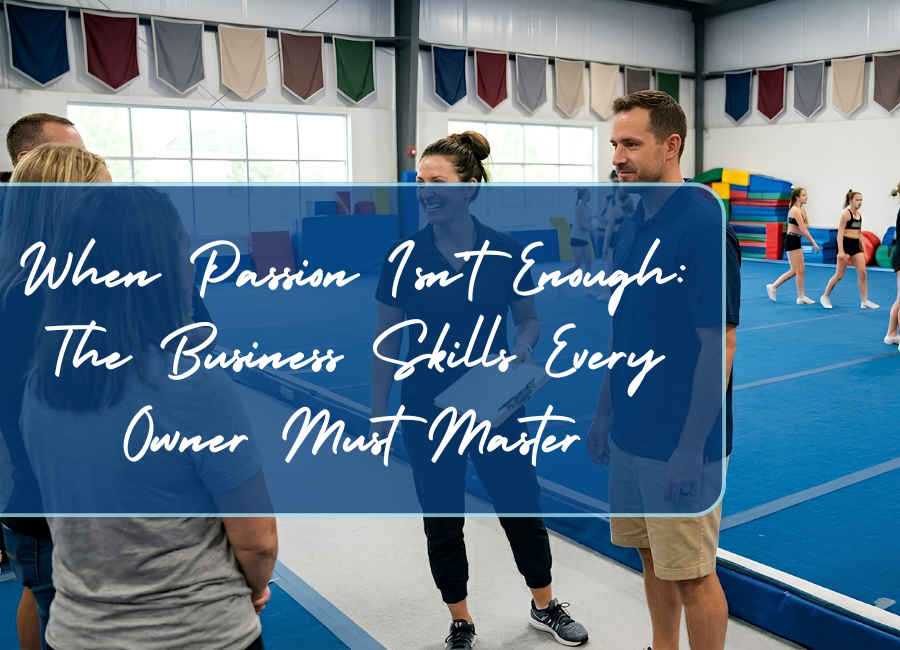
Most cheer gym owners did not start their business because they loved spreadsheets, policies, or operational systems. They started because they loved athletes. They loved coaching. They loved the sport. They had a vision for creating something meaningful — a place where kids could grow, teams could thrive, and culture could be built with intention. That passion matters. In many ways, it is the reason gyms exist in the first place.  But passion alone does not pay bills, retain staff, solve communication issues, or create long-term stability. At some point, every gym owner runs into a difficult truth: loving what you do is not enough to sustain a business. Skills matter. Systems matter. Leadership matters. And avoiding that reality is one of the fastest ways to turn a calling into burnout. Passion Gets You Started — Skills Keep You Going Passion is often what gets a gym off the ground. It is what fuels the late nights, the sacrifices, the emotional investment, and the willingness to keep going when things feel uncertain. In the beginning, passion can cover a lot. It can make you resourceful. It can make you resilient. It can even make chaos feel manageable for a while. But eventually, the cracks start to show. As a gym grows, complexity grows with it. More athletes means more communication. More staff means more leadership. More revenue means more financial responsibility. More moving parts means more room for mistakes, inconsistency, and overwhelm. That is where many owners get stuck. Not because they do not care enough, but because they are trying to run a growing business on instinct alone. There comes a point where heart is still essential, but it is no longer enough by itself. The gym needs structure. The owner needs clarity. And the business needs skills that support the vision behind it. Learning business skills does not mean losing the heart of what you built. It means protecting it. Financial Literacy Is Non-Negotiable You do not need to become an accountant to be a strong owner. But you do need to understand your numbers. Too many gym owners avoid financial clarity because it feels intimidating, overwhelming, or emotionally loaded. They would rather focus on coaching, culture, or the day-to-day needs right in front of them. But when finances stay unclear, stress grows in the background. Without a working understanding of cash flow, payroll percentages, profit margins, pricing, and expenses, every decision starts to feel heavier than it should. Hiring feels risky. Growth feels confusing. Even a good month can feel unstable if you do not fully understand what the numbers are actually telling you. That is when owners start making emotional decisions instead of strategic ones. They underprice programs because they do not want to disappoint families. They delay hard decisions because they are afraid of what the numbers might reveal. They stay in a constant state of low-grade anxiety because money feels like something happening to them instead of something they can lead well. Financial literacy changes that. When you understand your numbers, you gain more than information. You gain control. You gain confidence. You gain the ability to make decisions from a place of clarity instead of fear. Clarity around money does not restrict freedom. It creates it. Systems Create Stability If everything in your gym depends on memory, personal effort, or figuring it out as you go, stress compounds quickly. In many owner-led gyms, this is exactly what happens. The owner becomes the system. They are the one holding all the answers, remembering all the details, solving all the issues, and filling all the gaps. At first, that can feel efficient. But over time, it becomes exhausting. When processes live only in someone’s head, consistency becomes fragile. Communication gets messy. Mistakes multiply. Staff rely too heavily on one person. And every season feels more reactive than it needs to be. Strong systems change that. Systems give your business rhythm. They help staff know what to do, how to do it, and where to go when questions come up. They reduce confusion, support consistency, and make it easier to deliver a strong experience to families and athletes no matter what is happening behind the scenes. That does not make your gym robotic. It makes it reliable. Reliable communication. Reliable onboarding. Reliable billing. Reliable scheduling. Reliable expectations. And when the gym becomes more reliable, the owner becomes less overloaded. Systems do not eliminate leadership. They make space for it. Leadership Is a Skill, Not a Trait One of the biggest misconceptions in gym ownership is the idea that great coaches automatically become great leaders. But coaching athletes and leading adults are not the same thing. You can be excellent on the floor and still struggle with difficult conversations, accountability, team clarity, or staff development. You can care deeply about your people and still avoid giving feedback because it feels uncomfortable. You can want a strong team culture and still unintentionally create confusion if expectations are unclear. Leadership is not something you either have or do not have. It is a skill. And like any skill, it has to be developed. That means learning how to communicate clearly. It means setting boundaries without guilt. It means giving feedback with honesty and respect. It means managing emotions — both yours and other people’s — without letting tension quietly build under the surface. When leadership development is ignored, the cost shows up quickly. Staff become unsure of what is expected. Frustration grows. Resentment builds. Turnover increases. And the owner ends up carrying even more because the team is not functioning with clarity. But when leadership is treated like a skill worth building, everything changes. People know where they stand. Accountability becomes healthier. Trust grows. Expectations are easier to uphold. And the team begins to operate with more confidence and alignment. Leadership is not about control. It is about guidance. Delegation Is Growth, Not Weakness Many owners hold on too tightly — not because they are controlling, but because they are tired, protective, and afraid that things will fall apart without them. That fear is real. When you have built something from the ground up, it can feel risky to let go of any part of it. No one cares like you care. No one sees everything the way you do. No one carries the same level of responsibility. But that is exactly why delegation matters. Delegation is not about disappearing from the business. It is about building capacity beyond yourself. It is about making sure the gym can function, grow, and stay healthy without requiring your constant physical and mental presence in every decision. Without delegation, growth hits a ceiling. The owner becomes the bottleneck. The team stays dependent. Burnout accelerates. And even success starts to feel heavy because every new layer of growth adds more pressure to the same person. Delegation done well is not reckless. It requires training, trust, systems, and clear expectations. But when it is done right, it strengthens the business and the people inside it. Strong leaders do not prove their value by carrying everything. They build teams that can carry the load with them. A MotUS Perspective At MotUS, we believe passion and professionalism must coexist. You can love the sport and learn the business. You can care deeply about your athletes and still build strong systems. You can lead with heart and still make strategic decisions. You can be mission-driven without being disorganized. That balance is what creates sustainable gyms. Because sustainability is not built on passion alone. It is built on the choices owners make to strengthen the structure around their passion. Final Word Passion may be the spark, but skill is the structure. If you want your gym to last, grow, and truly support the people inside it, investing in business skills is not optional. It is responsible leadership. Learn the business. Protect your passion. Build something that lasts.
By Stacy Rowe June 6, 2026
Few decisions make gym owners more nervous than raising prices. You worry about how parents will react. You wonder whether families will leave. You question whether the increase will damage the trust you’ve worked so hard to build. These concerns are understandable. Cheer gyms are more than businesses — they’re communities. Parents and athletes often feel emotionally connected to the environment you’ve created. But here’s an important truth many owners eventually learn: avoiding necessary price increases can hurt your community far more than implementing them thoughtfully. When done with transparency and purpose, raising prices can strengthen your gym rather than weaken it. 1. Why Price Increases Are Sometimes Necessary Running a gym involves far more than the cost of a practice space. Facility rent, insurance, utilities, equipment, coaching salaries, and competition expenses all contribute to the overall cost of operations. Over time, these expenses increase. If pricing remains unchanged while costs rise, the financial pressure falls directly on the owner. Eventually, that pressure leads to burnout, staff turnover, or reduced program quality. None of those outcomes serve the athletes or families who rely on your gym. Raising prices is not about maximizing profit. Often, it’s about ensuring the gym remains stable and capable of delivering the experience families expect. 2. Transparency Builds Trust One of the most effective ways to implement a price increase is through clear communication. Parents are far more understanding when they know the reasoning behind a decision. Explaining how additional revenue supports coaching development, improved facilities, or better athlete programs helps families see the value behind the change. Transparency demonstrates respect for your community. It shows that you are making decisions thoughtfully rather than arbitrarily. When communication is clear, price adjustments become easier for families to accept. 3. Timing Matters The timing of a price increase can influence how it is received. Announcing adjustments well in advance allows families to plan and process the change. Sudden increases can create frustration or confusion, even if the reasoning is valid. Many gyms choose to align pricing adjustments with new seasons or registration cycles. This approach gives families a natural transition point and helps the change feel more organized. Thoughtful timing communicates professionalism and respect. 4. Value Must Be Visible Price increases are easier for families to accept when the value of the program is clearly visible. This doesn’t necessarily mean adding new features or services. Sometimes it means simply highlighting the strengths that already exist within your gym — experienced coaching, safe training environments, strong athlete development, and supportive community culture. Parents want to know that their investment is contributing to something meaningful. When the value is evident, pricing feels justified. 5. Confidence From Leadership One mistake owners often make when raising prices is apologizing excessively. While empathy is important, constant apologizing can unintentionally signal that the decision was wrong. Confident leadership reassures families that the change is part of responsible business management. When you believe in the value of your program, families are more likely to believe in it as well. Leadership sets the tone. 6. A MotUS Perspective MotUS was founded on the idea that gym owners should not have to navigate business challenges alone. Pricing conversations are part of responsible leadership. Sustainable gyms are able to invest in their staff, their athletes, and their facilities. Healthy businesses create healthy communities. Final Word Raising prices is never easy, but it can be necessary for the long-term success of your gym. When handled with transparency, respect, and confidence, price adjustments can strengthen trust rather than damage it. Your community wants your gym to succeed — because when your gym thrives, their athletes thrive too.